Luke 13:5 I tell you, no! But unless you repent, you too will all perish.”
In my prior post, I talked about the meaning of repentance in the Old Testament. In this one, I’ll discuss what it means in the New Testament.
Of all the posts I’ve written over the years, these two on repentance and one I’ll soon post on our purpose in life have probably had the greatest impact on my daily life, and I believe they will affect yours too.
This is one of my longer posts, so if you don’t want to wade through the supporting details, feel free to jump to the summary at the end.
Repentance in the New vs. Old Testament
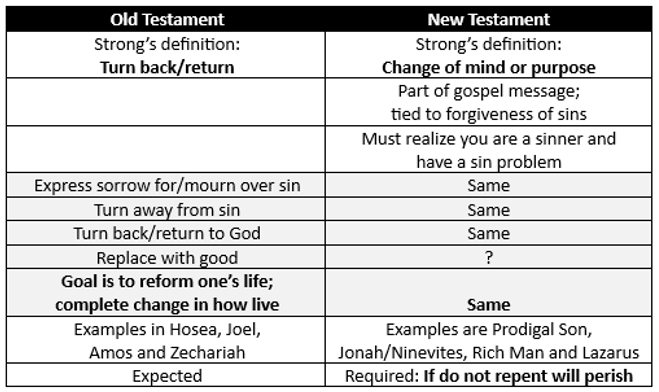
Repent in the New Testament has a similar meaning to that in the Old Testament, which is to express sorrow over sin, turn away from sin and turn back (or return) to God. In both Testaments, the ultimate purpose of repentance appears to be a change in how one lives (self-focused and sinful to God-focused with less sin).
However, repent is defined differently between the two Testaments according to Strong’s Concordance, which can create some confusion. In the Old Testament, Strong’s defines the Hebrew word for repent as “turn back/return.” In the New Testament, it defines the Greek word for repent (metanoeo) and repentance (metanoia) as a “change of mind or purpose.”
Also, in the Old Testament, repentance seemed to be something that the Israelites were to do on an ongoing basis, and it was not part of becoming saved. In the New Testament, repentance is associated primarily with one’s conversion to become a believer (though Christians are to repent whenever they sin).
In addition, repentance takes on much greater importance in the New Testament. We first read about repentance in Matthew 3, when John the Baptist preached that people should repent and be baptized. In Matthew 4, Jesus started His ministry telling people to repent. Later, we read that Jesus’ disciples, Peter and Paul all wanted people to do the same. And importantly, God the Father wanted people to repent; in fact, He commanded it. Repentance, like faith, is part of the gospel, or the good news of salvation, and important for a person’s sins to be forgiven.
With God the Father, Jesus, Jesus’ disciples, Paul, Peter and John the Baptist all telling people to repent, it is important that we know what this word means.
Repentance (at conversion) is for Sinners who Know They Have a Sin Problem
“But when Jesus heard this, He said, ‘Those who are healthy have no need for a physician, but those who are sick…for I did not come to call (to repentance) the righteous (self-proclaimed) but sinners (those who recognize their sin and actively seek forgiveness). (Mt 9:12-13).‘”
Repentance begins with acknowledging that you are a sinner and that you have a sin problem. However, many people fail to do this. Why? According to Barna surveys, most don’t believe they sin much, let alone have a sin problem. Their attitude is likely something similar to this:
“Yes, I might sin some, but I don’t do anything really bad. I don’t murder. I don’t steal. I know that the bible says that you should “Do unto others as you would have them do to you,” and I try to live this way. I’m not perfect, but I believe I am a pretty good person. And besides, none of us really knows for sure whether we will make it to heaven, but I think my chances are are pretty good (so I don’t plan to change how I live).”
The problem with this view, though, is that it is contrary to Scripture. The Bible is clear that all of us sin because we have a sinful nature. And, we will experience God’s wrath (hell) if we don’t get our sins forgiven, and we need Jesus for that (which is why He came here).
If a person does not recognize their sinfulness and how much of a problem sin is, they won’t feel any need to repent. And if they do not repent, their life will not change. And, without a changed life, their claim to be a Christian hangs on a profession of faith or belief in Jesus that may or may not prove to be genuine if there are no deeds to back it up (see James 2:14, 17).
Repentance includes expressing sorrow for sin
Acts 2:37 When the people heard this, they were cut to the heart and said to Peter and the other apostles, “Brothers, what shall we do?”
Repentance at conversion includes expressing sorrow for and mourning over your sins. In several Old Testament books, we see sorrow and contrition from people who came face to face with the problem of their sins.
A good example is in the book of Joel, when the people of Judah were told that the day of the Lord – judgment day – was approaching. Through the prophet Joel, God told the people how to prepare for it. He said, “Turn and come to Me with all your heart (in genuine repentance), with fasting and weeping and mourning; Rip your heart to pieces (in sorrow and contrition) and not your garments. Now return (in repentance) to the LORD your God…” (Joel 2:12-13).
In Psalm 51:17, David said, “My only sacrifice to God is a broken spirit; A broken and contrite heart (broken with sorrow for sin), such, O God, You will not despise.
In the New Testament book of Acts, when Peter shared the gospel message about Jesus’ death and resurrection with a group of Israelites, they were “pierced to the heart” and asked Peter what they should do. He then told them to repent (and be baptized).
And in Jesus’ Sermon on the Mount in Matthew 5, He said that those who mourn (over their sins and repent) will be blessed and comforted.
In my experience of listening to various pastors/ministers who share the gospel in an effort to get people to say a sinner’s prayer, there is not enough emphasis on the gravity and consequences of our sins, and instead the emphasis is on accepting Jesus into your heart or as Lord. I am concerned that if we fall short here, the prospective believer may not be pierced to the heart and brokenhearted over their sinful way of life, and thus may not fully repent.
Repentance includes turning away from sin (at conversion and ongoing)
Acts 26:18 to open their eyes so that they may turn from darkness to light and from the dominion of Satan to God, that they may receive forgiveness of sins and an inheritance among those who have been sanctified by faith in Me.’
Acts 14:14-15 14 But when the apostles Barnabas and Paul heard of it, they tore their robes and rushed out into the crowd, crying out 15 and saying, “Men, why are you doing these things? We are also men of the same nature as you, and preach the gospel to you that you should turn from these vain things to a living God, WHO MADE THE HEAVEN AND THE EARTH AND THE SEA AND ALL THAT IS IN THEM.
It is not enough to mourn over our sins…we must do something about them. Repentance at conversion includes a decision – once and for all – to turn away (refrain) from those things that are sinful (darkness) and “to light.” After conversion, repentance becomes a daily exercise as we continue to sin (but hopefully less and less).
For example, if I complain each day about work, I need to recognize this as sinful, express sorrow over it, and make a concerted effort to stop doing it. It may not be easy, which means I’ll be repenting a lot, but it’s something I will aim to do because God wants me to.
Repentance includes turning back/returning to God (at conversion and ongoing)
Luke 1:15-16 15 “For he will be great in the sight of the Lord, and he will drink no wine or liquor; and he will be filled with the Holy Spirit, while yet in his mother’s womb. 16 “And he will turn back many of the sons of Israel to the Lord their God.
Acts 3:19 Repent, then, and turn to God, so that your sins may be wiped out, that times of refreshing may come from the Lord,
After we decide, at conversion, to turn away from doing, saying or thinking things that are sinful, repentance requires us to turn back to God to obey what He wants (to replace the bad with the good) so that our sins can be forgiven. When we sin after our conversion, turning back to God also becomes a daily exercise.
For example, if I’m temporarily upset with my spouse for saying something that bothered me, and if I lash out in response by saying something that is critical or demeaning, I must “return to God” by doing what He would want me to do, which is to tell her that I’m sorry for what I said. I may not want to do this, but as part of genuine repentance, I have to do it. Turning away from sin and back to God is something a believer will need to do on a regular (daily) basis in order to live in a way that pleases God.
The real purpose/intent of repentance is a changed life (that bears fruit)
2 Corinthians 12:21 I am afraid that when I come again my God may humiliate me before you, and I may mourn over many of those who have sinned in the past and not repented of the impurity, immorality and sensuality which they have practiced.
Acts 26:19-20 19 “So, King Agrippa, I was not disobedient to the heavenly vision, 20 but I openly proclaimed first to those at Damascus, then at Jerusalem and throughout the region of Judea, and even to the Gentiles, that they should repent (change their inner self- their old way of thinking) and turn to God, doing deeds and living lives which are consistent with repentance.
I believe the real purpose of repentance is not simply to turn away from sins A, B and C, and back to God each time; rather, it is a complete doing away with our old sinful way of life that was me-focused, and seeking to live a new life that is God-focused and bears fruit (produces good works). It involves more than a change of mind or purpose per Strong’s Concordance, to include a total change in how one thinks and acts and lives (see the table below).

This, my friend, is what God wants from all of His creation. Too many of us have mistakenly believed that becoming saved was crossing the goal line, and how we lived after that was really up to us, with no ongoing repentance needed. All we needed was faith. But that’s not true. Becoming saved enables us to live in a way that pleases God, but repentance is needed at the time of conversion and every day thereafter to help us live the way God wants us to. It takes both – faith and ongoing repentance – to produce the holy life and good deeds that God wants from His creation.
Summary
Repent is arguably one of the most important terms in the New Testament. It is part of the gospel message of salvation right alongside faith. It relates to the forgiveness of sins. Jesus, Jesus’ disciples, Peter, Paul and John the Baptist all preached that people should repent. God commanded it. And Jesus warned, “Unless you repent, you will perish.”
And yet, many people will not. Why? Because they see no need to. They believe that sin is not a big deal, they don’t sin much, and they are probably good enough to get into heaven on their own. My friends, that is a grave mistake.
Repentance begins with acknowledging that you are a sinner and have a sin problem. You express sorrow for and mourn over your sins. You turn away from committing sins and turn back or return to God in an effort to obey what He wants you to do. This covers most of what it means to repent, but not all.
The ultimate purpose of repentance is to completely change one’s life. It is a 180 degree turn from living a sinful life that is focused on self to living a godly life that is focused on pleasing our Creator. This begins at conversion and continues throughout the rest of a one’s life. Ongoing repentance is not easy to do, but necessary in order to live in a way that pleases Him, which is what He wants.
Repentance is a big deal. Those who truly repent and have genuine (saving) faith in Jesus as Lord are saved, and the angels rejoice when this takes place. Those who fail to truly repent will suffer God’s wrath forever. God is patient with His creation and wants all to repent. He will even send trials and problems your way in an effort to get you to do so. But if you continue to ignore Him, at some point He will no longer pursue you, and you will face Him in judgment (see Amos 4) with no excuse to offer.
My friend, have you repented?
Luke 15:7 I tell you that in the same way there will be more rejoicing in heaven over one sinner who repents than over ninety-nine righteous persons who do not need to repent.


Leave a Reply