Romans 10:13 for, “Everyone who calls on the name of the Lord will be saved.”
One way for a person to become a Christian is to “call upon the name of the Lord,” which is what Romans 10:13 appears to say. But can a person simply say this phrase and be saved, or is there more to it than that? From my review of this verse and the surrounding ones, there is more that a person must do in order to have assurance of their salvation.
Introduction
The phrase, “call upon the name of the Lord,” can be found in Romans 10:13, Acts 2:21 and Joel 2:32. The former two simply quote Joel 2:32, so reviewing its context will be important.
Of these, Romans 10:13 is likely referenced most often by Christians, and may even be used by some as the basis for their salvation. However, this verse is the culmination of what Paul had said in Romans 10: 8-12, so one must review these to know what Romans 10:13 really means. I’ve included the entire section below, and highlighted key phrases and terms.
Romans 10:8-13 8 But what does it say? “The word is near you; it is in your mouth and in your heart,” that is, the word of faith we are proclaiming: 9 That if you confess with your mouth, “Jesus is Lord,” and believe in your heart that God raised him from the dead, you will be saved. 10 For it is with your heart that you believe and are justified, and it is with your mouth that you confess and are saved. 11 As the Scripture says, “Anyone who trusts in him will never be put to shame.” 12 For there is no difference between Jew and Gentile– the same Lord is Lord of all and richly blesses all who call on him, 13 for, “Everyone who calls on the name of the Lord will be saved.”
In this post, I’ll discuss each of the bolded phrases and terms, as an understanding of them will help us know what it means to call upon the name of the Lord for salvation. I’ll also briefly address Joel 2:32 and then end with a summary. If you don’t want to “wade” through all of the supporting details, feel free to jump to the end.
The word is near you; it is in your mouth and in your heart (Romans 10:8)
First, it’s important to note that several of the phrases and terms Paul uses in Romans 10 come from Deuteronomy, as shown below. Why Paul chose to do it this way I’m not sure other than to possibly appeal to the Jews in his audience, for they likely knew Deuteronomy well and if Paul could tie some Old Testament verses to salvation in the New, that might help convert some of the Jews, which is what he desperately wanted (see Romans 10:1).
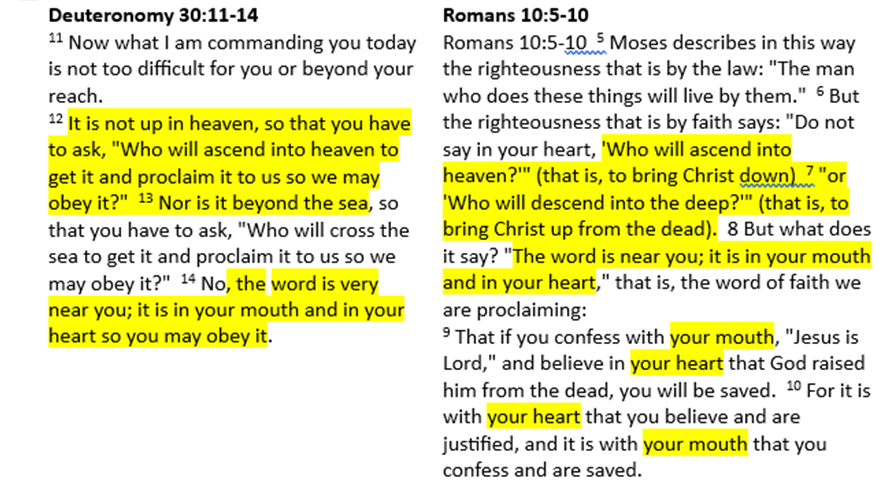
The context for Moses’ comments about his “command” not being “too difficult” for them (verse 11) and the “word is very near you; it is in your mouth and in your heart” (verse 14) is this: Moses had already told the Israelites over and over (as recorded in the earlier chapters of Deuteronomy) of their need to obey God’s commands (he mentions “obey” 29 times), else they would run the risk of abandoning God to worship false gods. He also wanted them to love and serve God with all of their heart. If they obeyed God, they would be blessed and have (a long) life; if they disobeyed, they would be cursed. Thus, they clearly knew his command (it was in their heart) and they had likely even told others about it (it was in their mouth) so it was everywhere known; they just needed to obey what they knew.
The context for Paul’s comments in chapter 10 is somewhat similar to that for Moses. He had told his audience over and over about how to be right with God, which is by faith rather than obedience to Old Testament laws. Thus, the good news of salvation was in their heart (they also knew of it) and in their mouth (they had talked with others about it); they just needed to believe it, and if they did, they would be blessed.
The main difference between the two sets of verses is that in Deuteronomy, obedience to commands brings blessings and life; in Romans, it is faith (or obedience to Paul’s gospel message) that brings blessings and eternal life.
If we view Paul’s use of “mouth” and “heart” in this way – as an attempt to simply use some of the same words Moses used and apply them to the new covenant concept of salvation – they take on less importance in Romans 10:9-10, and as such, we don’t have to “rack our brains” in trying to decipher what confession entails (does it have to be verbal or can it be done quietly?) or what “in the heart” means. Instead, we can focus on what we already know to be true: that if you believe in or have faith in Jesus, you will be made right with God.
Secondly – and this relates to the above – it’s important to note that even if we don’t fully understand some of the phrases and terms Paul uses in Romans 10:8-13 (let’s say our interpretation of “mouth” and “heart” above are wrong), it doesn’t matter that much. Why? Because we already know from prior chapters in Romans that a person is saved, or made right, by faith in, believing in, or trusting in Jesus (Paul uses these terms interchangeably, but uses the term “faith” far more often – 40 times in fact). Here are examples of how Paul says a person is saved:
- Romans 1:16-17 16 I am not ashamed of the gospel, because it is the power of God for the salvation of everyone who believes: first for the Jew, then for the Gentile. 17 For in the gospel a righteousness from God is revealed, a righteousness that is by faith from first to last, just as it is written: “The righteous will live by faith.”
- Romans 3:22 We are made right in God’s sight when we trust in Jesus Christ to take away our sins. And we all can be saved in this same way, no matter who we are or what we have done.
- Romans 3:25 For God sent Jesus to take the punishment for our sins and to satisfy God’s anger against us. We are made right with God when we believe that Jesus shed his blood, sacrificing his life for us.
- Romans 3:28 So we are made right with God through faith and not by obeying the law.
As such, whatever Paul meant by the phrases, “confess with your mouth,” “believe in your heart,” and “it is with your mouth that you confess and are saved” should not detract us from understanding Paul’s main message in Romans – that a person is made right with God (or saved) by faith in His Son.
The word of faith we are proclaiming (Romans 10:8)
This is simply the gospel message of salvation, which is by faith in Jesus.
Confess with your mouth, Jesus is Lord (Romans 10:9)
The phrase “confess with your mouth, Jesus is Lord” is difficult to understand in the context of salvation, for nowhere else in the Bible is it mentioned. On the surface, it appears that it is something a person must do in addition to believing in the gospel message. However, this is inconsistent with what Paul said in the prior chapters of Romans, where faith or belief alone made a person right with God. So, it leaves us with questions, and we must look for clues to try to make sense of this.
If we start with the definition of “confess” using Strong’s Concordance and Webster’s 1828 Dictionary, we see that it has a few different meanings.
One is to acknowledge, admit or agree, and the opposite of which is to deny, as shown here: Matthew 10:32-33 32 “Everyone therefore who shall confess Me before men, I will also confess him before My Father who is in heaven. 33 “But whoever shall deny Me before men, I will also deny him before My Father who is in heaven. Thus, using this definition, “confess with your mouth, Jesus is Lord” means to acknowledge, admit or agree that Jesus is indeed Lord. This could be verbally in front of others or by yourself.
A second meaning is to “publicly declare a belief in and adherence to something as true.” We see this in the New Living Translation, which uses “openly declare” instead of “confess.” Thus, using this definition, to “confess with your mouth that Jesus is Lord” means that you must openly or verbally declare this in front of others – such as before or after believer’s baptism – and thus give witness to others that Jesus is not only the Lord but your Lord. The problem with this view though, is that nowhere else in the New Testament does it say this. Salvation is by faith or belief, and God’s grace, and some verses include repentance, but none of the salvation-related verses in the New Testament say anything about the need to verbally profess this in front of others, so the act of doing so does not appear to be necessary for salvation.
Another idea on what the phrase “confess with your mouth” means is that it is evidence of one’s salvation rather than a requirement for it. This is based upon verses such as Luke 6:45, where we learn that a person’s mouth (what they say) reflects what is in a person’s heart(“A good person produces good deeds from a good heart, and an evil person produces evil deeds from an evil heart. Whatever is in your heart determines what you say.”). Thus, if you truly believed in your heart the gospel message, you would be saved, and you would therefore say (and do) things that are consistent with this, including confessing the fact that Jesus is Lord.
In terms of the phrase, “Jesus is Lord,” there doesn’t appear to be anything significant about its wording, as Paul refers to Jesus as Lord fifteen times in the book of Romans and in various ways (Jesus Christ our Lord, Jesus our Lord, Lord Jesus Christ). However, I believe he used this phrase to clearly show that a person can’t be saved if they only believe Jesus was a good man or a prophet; to be saved, a person must acknowledge and believe that Jesus is God incarnate (Romans 9:5 Theirs are the patriarchs, and from them is traced the human ancestry of Christ, who is God over all, forever praised! Amen). And, if Jesus is God and Lord, then we – saved or not – should have some allegiance to Him and seek to obey what He says.
So, how are we to interpret the phrase “confess with your mouth that Jesus is Lord?” To be saved, a person must acknowledge, admit or agree with the fact that Jesus is God (and thus has the power and authority to forgive a person’s sins and give them eternal life). I do not believe it matters whether you proclaim this loudly to others or quietly to yourself, so long as it reflects the belief in your heart. However, it must be something that you are not ashamed of (according to Matthew 10:32-33) – even when faced with persecution for believing it. In the Parable of the Sower, we read that some people heard and understood the gospel message of salvation and received it with joy, but then fell away when they experienced problems or were persecuted for believing God’s word, and thus did not produce any fruit. As such, they were not saved. If you are unwilling to confess that Jesus is Lord in times of peace or persecution, it shows that you do not truly believe in your heart that He is Lord, and thus you are not saved.
Believe in your heart (Romans 10:9)
Paul’s adding of the phrase “in your heart” to the command to believe in Jesus for salvation is most likely out of his desire to have continuity with the “mouth” and “heart” terms Moses used in Deuteronomy rather than requiring something extra (such as simply believing).
However, it’s my strongly held view that believing in Jesus for salvation must be with one’s heart and not mind only. In the Bible, the word heart refers to more than just a person’s mind or understanding to include their will, emotions and moral conscience (Vine’s Expository Dictionary). I believe that there are many professing Christians who believe in Jesus with their mind, but not with their heart, and as such, are not saved.
Calls on the name of the Lord (Romans 10:13)
The phrase, “for Everyone who calls on the name of the Lord will be saved,” can be interpreted in two different ways.
In one interpretation, the person who calls upon the name of the Lord already believes and trusts in Jesus, and is simply calling to Him or invoking His name in prayer and worship. This is supported by the following verses:
- Romans 10:11 As the Scripture says, “Anyone who trusts in him will never be put to shame.” Thus, “calls” in verse 13 and “trusts” in verse 11 mean the same thing.
- Romans 10:14 How, then, can they call on the one they have not believed in? Thus, one has to believe before they call, and if they already believe, they would appear to be saved.
Another interpretation places more weight on Joel 2:32, where people were told to do this to be saved from judgment. In that case, the people would be calling out to God to be saved from physical and spiritual destruction.
However, Paul’s main point in Romans 10:13 does not seem to be on the word “call” but rather “everyone” (or “whoever” depending upon the translation you use), as he wants to emphasize that salvation is available to all people – Jews and all Gentiles – and that anyone can become saved (it is easily “within reach” or “near to you”).
With that said, I believe it’s very important to realize that the one who calls upon the name of the Lord Jesus – the one who believes in and trusts Him – is also expected to obey Him. We see this in Luke 6:46, which says, “Why do you call Me, ‘Lord, Lord,’ and do not do what I say? I believe too many professing Christians fall short here, as they claim that Jesus is their Lord and that they are saved, but their way of life has not changed since before they became a Christian. This calls into question whether they were truly saved.
Joel 2:32
And everyone who calls on the name of the LORD will be saved; for on Mount Zion and in Jerusalem there will be deliverance, as the LORD has said, among the survivors whom the LORD calls.
The context for this verse in Joel is this: A plague of locusts had just destroyed the crops and trees and land as punishment or judgment for the sins of the people in Judah and Jerusalem, and as a sign that the Day of the Lord was coming. This would be a day of salvation for believers but final judgment for unbelievers. In response to this, God told the people to fast, weep, mourn, repent and turn back to God, and acknowledge who God is (merciful, compassionate, slow to get angry, filled with unfailing love). If the people truly repented, God would restore and bless them, perform many signs and wonders, and pour out his Holy Spirit upon those who respond to Him in faith. Although the Holy Spirit was poured out at Pentecost, as a possible partial fulfillment of this prophecy, it appears that the signs and wonders (sun turned into darkness, moon turned into blood) and (additional) outpouring of God’s Holy Spirit Joel mentions are for the Day of the Lord, when people will be judged (with some going to heaven and others to hell).
Thus, calling upon the name of the Lord in Joel appears to be a way for people to escape God’s judgment by becoming saved, and is in response to repenting and turning back to Him. Thus, it is calling out to the Lord with faith in Him, and after repenting.
Now, I don’t know whether Paul had repentance in mind when he quoted this verse, or whether his point was that “everyone” can become saved, but we do know from other verses in the Bible that a person must repent to become saved (see Luke 13:3, 5). This illustrates why it’s dangerous to pick out one salvation verse in the Bible, such as John 3:16, and claim you are saved based upon that verse, when other verses may require that a person do something else (repent, have faith, “Come to Me”, be born again, etc.) to be saved. To understand salvation, one has to look at all of the verses that talk about salvation and understand how they relate to each other.
Summary
Romans 10:13 (for, “Everyone who calls on the name of the Lord will be saved.”) presents what appears to be a clear and easy way for a person to become saved, but it is not recommended that a person use this as their basis for becoming a Christian given the different ways that this verse can be interpreted, and the need to understand the preceding verses that contain important details about salvation.
Salvation is available to anyone and everyone who puts their faith in Jesus, or believes in their heart that Jesus is God. A person does not have to verbally proclaim this to others, but can’t be ashamed of it either. A person who believes that Jesus is Lord should have some allegiance to Him and seek to obey Him. An unsaved person who believes in or trusts or puts their faith in Jesus as Lord can become saved by calling out to Him in prayer and asking to be saved. Repentance, which is not specifically mentioned in Romans 10:8-13 but is related to Joel 2:32, is also necessary. A saved person who already believes in Jesus can call out to Him in worship and prayer.
Prayer
Dear Jesus,
I’ve long considered myself to be a Christian, but now that I think about it more, I’m not so sure. I’ve called upon the name of the Lord for salvation, as I wanted to escape hell, but I’m not sure I really have faith – the kind Paul talks about – in Him. I don’t go to church much (or at all). I’m not reading in your word. And I don’t pray that often. For years, I tried to be a good Christian, but that didn’t work out for me. I prayed to You over and over for help with problems I had at that time, but You didn’t do anything. It’s as if you didn’t care.
So, I gave up on You. I decided to live my life my way, apart from You. The only problem is, it’s not really any better than before. Yes, I have done some fun and exciting things here and there, but I’ve not found any inner peace or joy. In fact, I’ve done some things that I now regret. And my problems haven’t gone away like I hoped they would.
Maybe you are working in my mind now to make me reconsider my life. Assuming you are, here’s what I will do. I will try the Christian life again. This time, I will surrender myself completely to You, and seek to do Your will, not mine. I will commit to read in Your word. I will commit to pray to you throughout the day. And I will seek You when I need to make decisions. I want You to make changes in my life – in what I think and in what I do. I long for relief from my anxieties and stress and problems and guilt; I want to experience peace and joy and contentment and good relationships with other believers.
So I ask You now – please forgive me from my sins, and make me a believer. I surrender myself completely to You, and I eagerly look for evidence of You working in my mind and my life. Thank You for hearing my prayer.
Amen.
 Salvation Summaries
Leave a comment