The amount of anger and violence attributed to God in the Old Testament is a problem for many people. It can prevent non-Christians (atheists, agnostics) from becoming a Christian (“Who in the world would want to worship a God like that?”). But it can also shake the faith of some Christians to the point that they disregard God and live apart from Him (for they don’t want to worship an angry and violent God either).
Ultimately, it’s a question about God’s character (who is He really?) and whether He can be trusted. Is God loving, merciful and forgiving like we hear and read about, and how Jesus is portrayed in the New Testament? Or, is He a mean, angry and violent God who does whatever He wants, and cannot be trusted, so why have anything to do with Him?
From having read most of the Old Testament several times to research this topic, I believe we can make sense of God’s anger and violence in the Old Testament without impugning His character, and still view Him with awe and respect.
In this post, I’ll provide an overview of the Old Testament and address God’s anger. In future posts I’ll discuss God’s violence. These posts are long (sorry) given the complexity of the topic (entire books have been written on this subject), but if you don’t have time or want to read the supporting details, you can jump down to the conclusion at the end of each post.
Overview of the Old Testament
I’ll give you my “take” on what the Old Testament is about, but there are different ways to summarize it given all of the events that took place over roughly 1,000 years.
In the beginning, God created mankind and all that he needed to live and procreate, but over time, mankind became increasingly wicked, corrupt and violent to the point that God had to wipe out (via a flood) all of the people and animals He had created and start over with Noah’s family and the animals on the ark.
After the flood in Genesis, the Old Testament is largely about God trying to move a stubborn, rebellious and wicked group of people – known as Israel – from point A (Egypt) to point B (the promised land of Canaan). However, this was no easy task. Most of the Israelites complained against God and lacked faith in Him all along the way. This forced God to punish them in different ways and at different times, but all in an effort to get them to turn back to Him.
Also, the Israelites had to drive out their ungodly enemies who lived in the promised land of Canaan, and a number of them were giants (the offspring of fallen angels and earthly women) who were much bigger and stronger than the people of Israel. This required God to get involved – both directly and indirectly – to help Israel survive and not be eliminated as a race, which is what Satan wanted. The result was many battles with lots of killing and death.
God had initially used judges to help Israel make right decisions and fight against its enemies, but the people of Israel wanted a king instead (to be like other cities in the area), so God allowed kings to rule Jerusalem and Judah. Many were evil.
God then raised up prophets to warn Israel of punishments if they continued to disobey Him, but Israel disobeyed anyway. As a result, God was forced to ratchet up His punishment to the point where He allowed Israel’s enemies (the Babylonians and Assyrians) to overtake them, destroy Jerusalem, and exile them to foreign lands. It was at that time that a small remnant of Israelites finally turned back to God. God, in turn, enabled this remnant to move back to Jerusalem, rebuild the temple and offer sacrifices again.
With Israel back in Jerusalem, this allowed for the eventual fulfillment of Old Testament prophecies about Jesus’ birth, death and resurrection, which we read about in the New Testament.
Making Sense of God’s Anger
OK, now that you know what the Old Testament is about, let’s move on to God’s anger. I’ll start with the bad news.
In the Old Testament, God was often angry. If you search for the words “anger, angers, angry and angered,” you will see that God was angry, or viewed as angry by the author, more than 230 times. He was angry in 75% of the books in the Old Testament, primarily in Jeremiah, the Psalms, Deuteronomy, Ezekiel and Isaiah (see below).
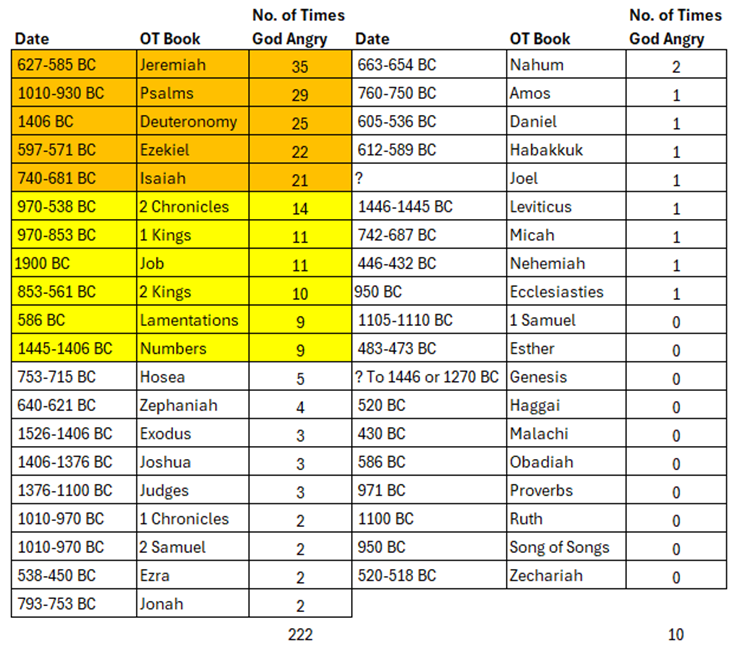
Also, God didn’t just get angry. There were times when He “burned” with anger, was “exceedingly angry” or had “fierce” anger.
To understand why God became so angry so often, I reviewed each book of the Old Testament (except a few) and summarized how many times God was angry and why. Below are examples.
Genesis. There is no evidence that God got angry in Genesis even though a number of bad things happened that may have warranted it. For example. Adam and Eve disobeyed God and their sin impacted all of mankind (it looks like if there ever was a time for God to get angry, it would have been at this!). Cain murdered Abel (we see God counseling Cain when he was angry and prior to this event). The entire human race became wicked and violent because of the Nephilim and led to God’s wiping out of all of mankind and animals (this grieved God). The people of Sodom and Gomorrah were so wicked they had to be destroyed. Etc.
Exodus. The first instance of God getting angry in the Bible is in Exodus. Moses had pleaded and protested to God 5 times about not wanting to lead Israel out of Egypt and on the fifth time, God became angry. Why? Moses’ reluctance to do this was preventing God from freeing Israel from their enslavement and removing Egypt’s injustice of Israel. So, how did God respond to Moses’ final plea? Did God “zap” him? No. God simply proposed that Aaron, Moses’ brother, join Moses in speaking to Pharoah. Here we learn that God’s anger related to the injustice of Egypt on His people and Moses’ reluctance to help God eliminate that injustice. The second instance was a warning – God would get angry at anyone who took advantage of a widow or orphan; this shows God’s justice for those who are vulnerable. The third was when Israel worshiped a golden calf while God was speaking with Moses on the mountain. As was clear here and in a number of OT books, God does not tolerate the worship of false gods.
Numbers. God got angry 9-10 times, with nearly all of these against Israel and their rejection of and/or contempt towards Him. For example. In chapter 11, when Israel complained about their hardship and wanted to go back to Egypt and slavery, it was a rejection of God, so He punished them by killing some and sending a plague to turn them back to Him. In chapter 12, when Aaron and Miriam complained about Moses marrying a Cushite woman – likely out of jealousy of her influence over Moses and about Moses’ authority – they were rejecting God’s choice of Moses, so He punished Miriam (she was named first in the verse so she likely started it). In chapter 14, when Israel refused to listen to God again and again, and treated Him with contempt, God punished all of Israel by denying them entrance in the promised land. In chapter 25, some Israelite men had sex with Moabite women who seduced them and (many) other Israelites to worship Baal, God punished Israel by sending a plague that killed 24,000. Here we learn that God is a jealous God who does not tolerate worship of false gods.
Deuteronomy. God was angry 25 times in this book, but it’s not as bad as it sounds. At least half of these are simply Moses recounting times when God was angry in the past against Israel for their constant complaining and rejecting of Him in the wilderness. The other half are instances where Israel worshiped foreign gods, or in “what if” situations (e.g., IF Israel were to worship foreign gods, THEN God would become angry). Here again we see that God is a jealous God who has righteous anger when His people commit acts of evil by abandoning Him to worship foreign idols and gods.
1 Kings. God became angry with Solomon, certain other kings and Israel 13 times in this book, and they were all for these reasons: 1) Sins against God, 2) Hearts that turn away from God, 3) Committing evil acts, 4) Worshiping foreign gods and idols, 5) Causing other people to sin. In short, God gets angry when we sin against Him by disobeying Him and when we cause others to sin. This is righteous anger.
2 Kings. God was angry 9 times in this book and it was all righteous anger in response to these things: 1) A king or Israel did evil in God’s sight and/or acted wickedly, 2) A king or Israel worshiped Baal, sacrificed their sons and rejected God, and 3) A king or Israel disobeyed God.
2 Chronicles. God is described as being angry 14 times in this book, but it is largely (if not exclusively) righteous anger. He was angry at Israel’s sinfulness, their abandonment of God, their worship of foreign gods, and their evilness and disobedience.
Isaiah. God was angry more than 25 times in this book. His anger was directed at Israel primarily for their wickedness, idol worship and sin. It was righteous anger. Israel murdered its own people, treated people unjustly, worshiped false gods, etc., so God punished to correct and purify them from their sin. He ratcheted up His punishment to get them to repent but they would not.
Jeremiah. God was described as angry 35 times, the most of any OT book. Why? Because of Israel’s and Judah’s ongoing disobedience and wickedness. Israel refused to acknowledge or obey God, worshiped Baal, had shrines on every hill, committed adultery, burned their sons and daughters (sacrifice to gods), turned away from and abandoned God, refused to repent, were wicked, etc.
Conclusion
God got angry a lot in the Old Testament. This is tough for most people to accept, for it goes against the positive traits we hear about God, such as His love, mercy and forgiveness. Also, it calls into question His character and who He really is. Would God get (that) angry with me? Can I trust Him to treat people fairly?
From a review of most of the books in the Old Testament, we see that most of God’s anger was directed at Israel due to their disobedience and wicked behavior, with the worshiping of false gods high on this list of wrongs. Had Israel simply obeyed God, there would have been far less anger recorded in the Old Testament, far fewer books in the Old Testament, and likely a “non-issue” for most people today.
Also, we see that most of God’s anger was “righteous” anger. What is righteous anger? Per AI, it is (God’s) anger in response to sin, injustice or moral wrongdoing. It stems from God’s nature as holy and just. It differs from human anger, which often is impulsive or irrational, and instead is viewed as just and appropriate. As such, God’s righteous anger was not a bad thing; it was a correct response to wicked behavior and injustice. We (Christians) should have righteous anger when we see wickedness and injustice taking place, especially against those who are most vulnerable.
Last, we must not lose sight of the fact that God – according to certain authors of the Old Testament and God Himself – is described as “slow to anger.” We read about God’s anger and punishment, and often assume it took place right after a certain event, but it’s possible that God withheld His anger for days, weeks, months and even years before He finally became angry and issued punishment (to correct or as judgment). Remember that Israel was enslaved in Egypt for 430 years before God took action to rescue them.
In future posts, I’ll address God’s violence, including His harsh deterrents, punishments and involvement in many battles where He directly or indirectly killed people. This, I believe, is a bigger concern for most people.
 Salvation Summaries
Leave a comment