In my last post, I mentioned that the Bible contains several “tests” you can take to determine if you are a Christian (or just think you are). This post reviews one such test in Matthew 7:13-14, which is a set of verses known as The Narrow and Wide Gates.
Matthew 7:13-14 13 “Enter through the narrow gate. For wide is the gate and broad is the road that leads to destruction, and many enter through it. 14 But small is the gate and narrow the road that leads to life, and only a few find it.
Context
The Narrow and Wide Gates is at the end of Jesus’ famous Sermon on the Mount recorded in Matthew 5 – 7. His sermon begins with the well-known beatitudes (blessed are the poor in spirit, blessed are those who mourn over their sins, etc.), and then moves to a number of dos and don’ts in how a disciple should live. It ends with three illustrations.
The first illustration, in 7:13-14, identifies two types of gates (wide vs. narrow) that lead to two different roads or paths (easy vs. difficult) with two different outcomes (heaven vs. hell).
The second, in 7:15-23, includes two types of trees (healthy vs. unhealthy) that bear two types of fruit (good and bad) with the same two outcomes.
And the third, in 7:24-29, mentions two types of builders (wise vs. foolish) who build two different foundations (rock vs. sand) with the same two outcomes.
The illustrations are profound because of their simplicity, shared construction (two, two, two) and significant consequences.
But why are there three? They appear to be shown in a certain order. The gates likely represent the start of one’s journey in life (as a Christian or a non-Christian); the trees reflect how one lives along that journey (bear good fruit or bad fruit); and, the foundations represent how one will be judged at the end of their life (whether house built on rock or sand).
One verse appears to well summarize the meaning of all three illustrations, and it is Matthew 7:21, which says “Not everyone who says to Me, ‘Lord, Lord,’ will enter the kingdom of heaven, but only he who does the will of My Father who is in heaven.” In short, what determines where a person goes is their obedience in doing God’s will rather than their own.
Details
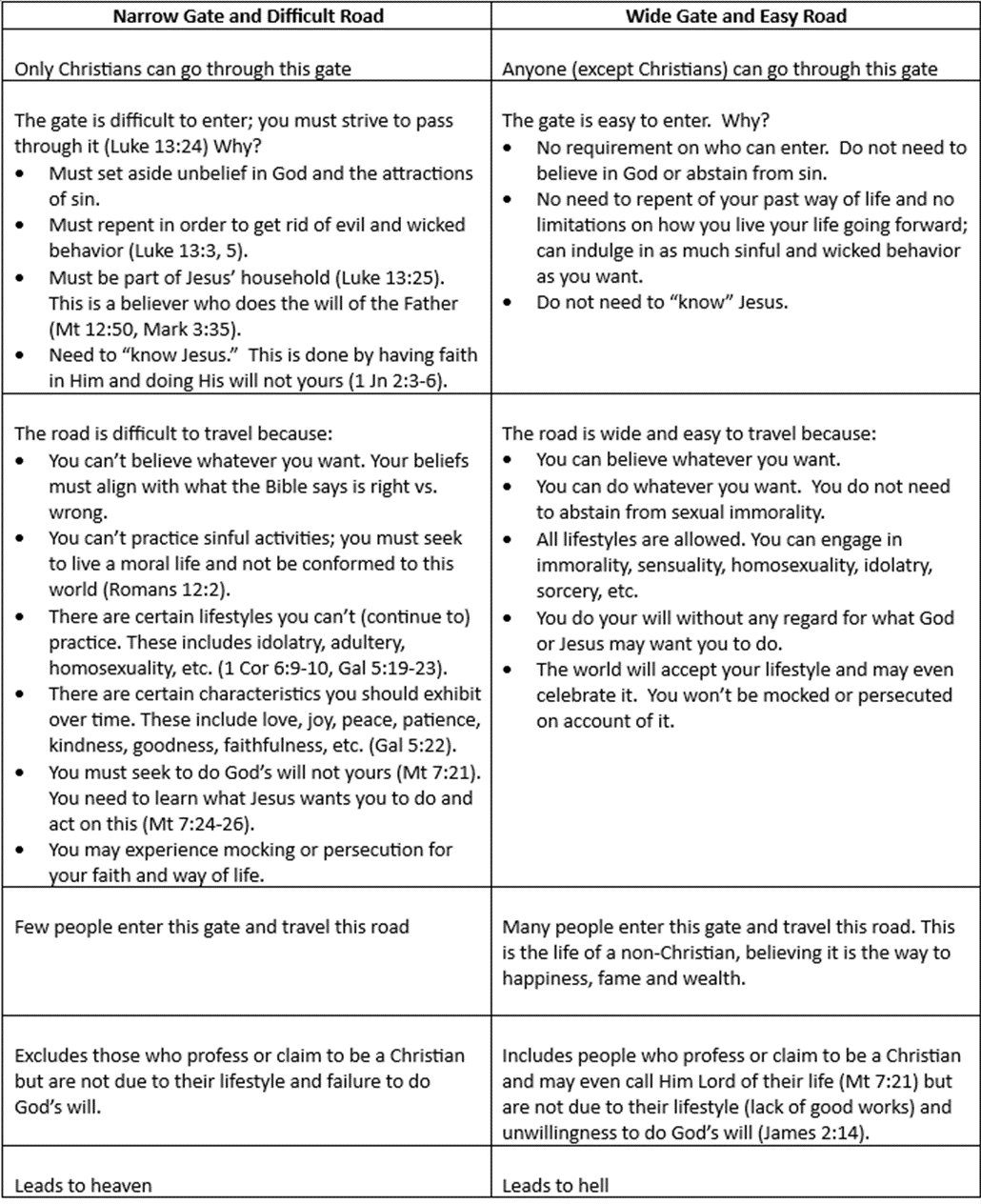
In The Narrow and Wide Gates’ illustration, there are two gates and two paths. There is a narrow or small gate that leads to a narrow path. This path is difficult to travel on, and few people do. This path leads to heaven. There is another gate that is wide. It opens up to a broad path that is easy to travel on, and many people do. However, this path leads to hell. Thus, there are only two paths or roads a person can take in their life, with one leading to heaven and the other hell.
Now, before diving into the details of these verses, let’s take a step back and ponder some of the big picture truths that jump out from these verses.
First, Jesus wants His disciples, and by extension anyone and everyone who hears His words, to go to heaven. That is why He tells His listeners to “enter through the narrow gate” (and thus avoid the wide gate). We see the same desire by God our Father in 1 Tim 2:3-4, where we read, “This is good, and pleases God our Savior, who wants all men to be saved and to come to a knowledge of the truth.” Please stop and think about that for a moment. God wants everyone – including you – to be saved. But, as we learn from the Gates’ illustration, God gives mankind a choice on what road they will take in life, and as such, where they will spend eternity.
Second, even though God wants everyone to go to heaven, most people will not, and instead end up in hell. This truth is hard to accept. It goes against the worldly view that heaven is a reward for those who do more good deeds than bad, and since “everyone is basically good,” most people will go there. Also, it raises the question of how a loving God could send anyone to hell. But again, as we read in the Gates’ illustration and elsewhere, God doesn’t want anyone to go there; those who do, do so by their own choice (and for those of you who may throw out the criticism, “But what about those who have never heard?”, I’ll address that in a different post).
Third, it may well be difficult to get into heaven. This is implied by the small gate and the narrow road. This is also contrary to the popular view – at least in many Protestant churches – that all one needs to do is “believe in Jesus” and you’re “in.” Believing in Jesus is required, but what does “believe” really mean? Does it mean more than we think it does? And how do faith, realizing one’s sinfulness, mourning over sin (repentance) and dying to self fit into the picture, as the Bible says that these also are needed for a person to become a believer?
OK, with these big picture truths out of the way, let’s move into some details I gathered from reading relevant Bible verses and trusted commentaries. Please read each column to determine which gate you entered, which road you are on, and where your destination may be.
Bottom Line
Jesus’ illustration of the Narrow and Wide Gates tells us who will go to heaven and who will go to hell, and as such, identifies a Christian from a non-Christian.
A Christian is one who has entered through the narrow gate (from having faith in Jesus, repented over their sins, and surrendered to Jesus to do His will) and begun to walk on the narrow path. The life of a Christian is not easy because of the different beliefs and lifestyle a Christian must hold relative to those of “the world,” and the mocking and/or persecution that may be experienced along the way. However, in the end, as a Christian, your willingness to do God’s will more than yours will put you on a foundation of rock not sand, and when judged, you will be granted entrance into heaven.
I believe it’s important to note that doing God’s will is a decision, a willingness and a sacrifice one makes, but it is not something we do every hour of every day, or necessarily every day. Also, it is possible to “backslide” for a time and still remain a Christian (I did in college and for a few years after that). However, the longer you backslide and do your will rather than God’s, the greater the odds that you never entered the narrow gate to begin with and are now on the wrong (broad) road.
Also, a Christian should not base the appropriateness of his or her lifestyle upon how their friends are living. A person may claim to be a Christian but not be (see Mt 7:21). Also, a non-Christian might live a more moral lifestyle than some spiritually immature Christians, but their destination is not heaven. The type of lifestyle you follow should be based upon what God wants you to do. For some examples, please read Jesus’ Sermon on the Mount.
And finally, for those who may believe that the lifestyle of a Christian is no fun, it’s important to realize that the life of a Christian produces blessings and more good changes (more love, peace, patience, kindness, goodness, etc.) than a non-Christian can experience (due to not being born again and not having the Holy Spirit within them), which makes the difficult journey worthwhile.
The bottom line is this: Are you living to please God or yourself? If you are living only to please yourself without any regard for what God wants you to do or how you should live, then you’re on the broad road, and you know where it leads. However, there is a “cost” in becoming a Christian that each person must consider. The choice is yours. The consequences are eternal.
 Salvation Summaries
Leave a comment