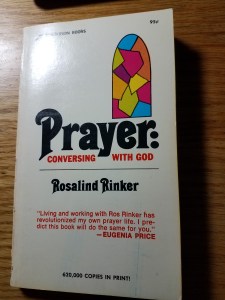
Rosalind Rinker, a missionary in China, wrote Conversing with God in 1959.
This small book of 117 pages has 11 chapters and 5 appendices. The chapters are: Three Prayer Meetings, Prayer is a Dialogue, What is Conversational Prayer, To Whom Should We Pray, Prayer Begins a New Relationship, Why Pray Aloud Together, Why Pray Alone, What is Faith, What is Unanswered Prayer, What are Faith-Sized Requests, When People Pray Together. The appendices are: Daily Quiet Time, Aids to Personal Worship, A Diagram of the Trinity, Heart-Searching Scriptures and Recommended Reading.
The focus of this book is on conversational prayer using the author’s interpretation of Matthew 18:19-20: “Again, I tell you that if two of you on earth agree about anything you ask for, it will be done for you by my Father in heaven. For where two or three come together in my name, there am I with them.”
Summary
Although there were several things I learned (conversational prayer, a little on how to pray and some on what it means to pray with faith) and liked (seek to be in Jesus’ presence when you pray, seek direction from the Holy Spirit in group prayers) about this book, it did little to improve my prayer life. I didn’t agree with the author’s interpretation of Matthew 18:20, and think she overstated the benefits of group prayer. Also, there were a number of issues the author did not reference or adequately address in view.
Main Points
- Definition of prayer – Prayer is a dialogue between two people who love each other.
- Purpose of prayer – To put God at the center of our attention; to forget ourselves and the impression we make upon others.
- How to pray – Select a specific place to go to each time you pray. Anticipate meeting Jesus in an intimate way. Seek to become aware of His presence with you when you pray. Let Him speak to you. Be “in tune” with Him until you become willing to hear what He has to say to you. Worship, love and adore Him. I like the author’s focus on Jesus when praying rather than what we as Christians so often do, which is to focus on our needs and wants.
- Praying with faith – The author uses the story of the bleeding woman – where she exhibited faith in Jesus to heal her – to illustrate how we are to pray by faith. Per the author, praying with faith means that you are to: 1) Understand that God is willing to give us what we ask for because of His love, kindness and mercy, 2) Ask for whatever you need, 3) Seek to be in God’s presence; to be close to Him, and 4) Believe that you will receive what you asked for; you should have a deep desire to receive an answer. She also said that you should not doubt when you pray, be specific,and picture yourself receiving it. Last, your prayers should be faith-sized requests, which means you are to pray for only what you believe God can and will do.
- Conversational prayer – The author defines this as two or more people who pray back and forth on a topic until a new topic is introduced by the Holy Spirit. This form of praying requires each person to take turns with the other(s) when praying and to focus on one topic at a time. The goal is to have the Holy Spirit determine what topics the people pray about or for. I had not heard of conversational prayer before, nor seen it practiced in the groups I’ve prayed with.
- How to have your prayers answered – You need to ask in Jesus’ name, let Jesus’ words abide in your heart, and be persistent (keep on asking, knocking and believing).
- Reasons for unanswered prayers – This results from a failure to forgive others, and other sins you have committed.
Deficiencies
- Who we are to pray to – the author did not have conviction in who we should pray to. She prays primarily to Jesus, but at times to the Father and the Holy Spirit. I wish the author would have provided more support here.
- Loose interpretation of Matthew 18:19-20 – The author seems to have the view that if two or more Christians pray together, and share the same view on what they are praying about (thus, they must be “in tune” with what Jesus wants), their prayer will be answered. However, I believe she takes verse 20 a little too far. In my opinion, this verse pertains primarily to elders or deacons in the church who are faced with a decision of whether to excommunicate a member due to unrepentant sin. In a situation like this, where they agree on the facts of the situation and what must be done, they have the assurance that Jesus will approve of their action. As such, I would not use this particular verse to form a convicted opinion that Jesus will always answer the prayer of two or more believers who share the same view on a particular issue.
- Benefits of praying with others – I think the author overstated the benefits of praying with others. Here are the benefits she mentions:
- The Holy Spirit can whisper the love plans He has for us.
- When we are consciously in His presence, He softens our hearts and minds, and we find ourselves changed and enabled to receive. When we pray together, we become bold and honest, and ask for things we never intended asking for at all.
- The more we pray with people, the more we begin to trust them, and the more honest we can be about our personal needs. Self-consciousness drops away and we can pray about our real problems, not just surface ones. Genuine “togetherness” is a God-given state, and hearts are joined in His presence.
- Praying with faith – When we pray, we need to do so with faith, and the author uses the example of the bleeding woman and Jesus to help us understand what faith is. The bleeding woman had faith that Jesus could and would heal her, she touched his garment, and was miraculously healed. However, there are many faithful people today with health problems as severe, or more severe, than that of the bleeding woman and whose prayers are not answered. Further, the bleeding woman saw and physically touched Jesus (his garment), which is not something we can do today. I thought the author should have provided information to address these two points and more examples of praying with faith given how important this is.
- Examples of prayers – I believe a book on prayer should provide the reader with examples of what good prayers look like and why. This could include actual prayers found in the Bible (such as Ephesians 1:17-19 or Colossians 1:9-12), or ones the author thought of. The author did not do either.
- Reasons for unanswered prayers – The author touched on this issue but did not address it in the level of detail I believe it needs based upon how much of a problem it is among Christians.
- The Lord’s prayer – There was no evaluation of, or reference to, the Lord’s prayer. I believe anyone who wants to learn how to pray must well understand this prayer that Jesus taught his disciples, and anyone who writes about a book about prayer should include at least a brief evaluation of the Lord’s prayer.
- Prayers in the Psalms – There was no evaluation of, or reference to, the many prayers found in the Psalms in terms of their structure, formality or common elements.
Sample prayer from reading this book
Dearest Lord Jesus,
I want to come into your presence and focus only on you. I want to love you and adore you, for you are my savior and my God. I want to hear from you and your Holy Spirit. Speak to me in this quiet place as I present my requests before you.
Jesus, I have one specific request I want to discuss with you at this time. My (fill in the blank) are still not saved. They only have a general belief in you rather than saving faith. I humbly ask that you soften their hearts this week, for I plan to meet with them on Saturday. Given me an opportunity to tell them about you, and open their eyes to see and ears to hear what I have to say.
Dear Jesus, I believe you will do this for me, for it is your desire, and mine, that they be saved. Let this encounter cause them to wonder about Christianity and salvation, and to be even more willing to hear what I have to say next weekend.
Thank you, my dear Jesus, for hearing and answering my prayer. I love you.
In your name I pray, Amen.
 Salvation Summaries
Leave a comment