In my last post, I shared a recent experience my wife and I had in witnessing to two Mormon Missionaries, and how our relationship with them ended unexpectedly. In this and the next two posts, I will share my general approach in witnessing (to taxi drivers), experience in witnessing to a devout Muslim, observations and concerns from reading the Qur’an, and recommendations on how Christians should witness to Muslims.
General Approach to Witnessing (to Taxi Drivers)
When I travel to the east coast (primarily Boston and New York) for work, I often witness to my taxi drivers (and going forward Uber drivers), many of whom are Muslim.
I usually start by asking the driver where he is from and how many days he drives per week. If he says he drives six or seven, I say, “it’s probably tough to find time to go to church!” If he drives only five days per week, I’ll ask if he does so on the weekend, and if he says “yes,” I’ll respond with the same comment above (it’s probably tough to find time to go to church…).
How he responds to my comment will determine the type of questions I’ll ask and statements I make as per below:
1) If he does not go to church, he’s an atheist, agnostic or practices a different religion, so I’ll ask questions to determine which “bucket” he falls into.
2) If he attends church infrequently, he likely considers himself to be a Christian but is probably not, so I’ll focus on how to know if you are one.
3) If he attends church regularly he might be a Christian, so I’ll ask questions or make comments to try to determine this.
4) If he does not attend church but instead attends a Mosque, synagogue or temple, I’ll ask him questions about how his religion compares to the Christian religion, and try to point out the differences I’m aware of with the goal of getting him to see why the Christian religion is unique.
If the driver is a Muslim, I typically start by asking what he knows about Christianity. Most say that Islam and Christianity are similar, and then the driver will add a comment about trying to do good things. Some have said they don’t know much about Christianity. I then ask if he has read the Bible, and the answer is almost always “no.”
After this, I share some of the differences between the two religions (a person does not get to heaven by being good, everyone sins and that is the problem, Jesus is the remedy for our sin problem, etc.). I also share my conversion story in college, since Muslims do not have a conversion experience.
Because most of my taxi rides are 20 – 40 minutes long, the above is all I can cover before the ride ends. However, it is my hope that these short conversations get the (Muslim) driver to think more about Christianity, and the changes in one’s lifestyle that result from being converted or saved.
Conversation with a Devout Muslim Taxi Driver
In one of my witnessing experiences in New York City, I encountered a devout Muslim who surprised me with his frankness and criticism of Christianity. After our conversation, I jotted down some notes and would like to share them with you.
His comments to me:
- Everyone is born a Muslim. A child’s parents may later convert that child to a different religion. All of the prophets in the Bible, including Moses and Jesus, were Muslims. Allah told them what to say.
- Allah will judge everyone when they die. He will ask them the same set of questions. If you do more good things than bad, you will go to paradise, but you may go to hell first for a while to “pay” for the bad things you did. Eventually, all Muslims will go to paradise. Jews and Christians will be judged on the basis of knowing that the Islam religion was available to them yet they ignored it (I wrote down that “they will all likely go to hell and stay there” but I don’t recall if this is what I understood from his comment or something he specifically said).
- God did not need to have a son. (He does not believe in the Trinity).
My questions to him:
- What is good? Is there a list of laws or good things must follow in Koran? Good is something you know in your heart.
- How do you know that Allah/God is real? Look at creation.
- What do you know about Christian religion? Not much.
- Have you ever read any of the Bible? No (and then some comment about it not being true).
- Why do you believe the Bible is not true? There are many versions of it; it has been corrupted over time.
- Is Jesus alive? Yes, he will come back to earth and then die like everyone else before going to paradise.
- Do you have standard prayers you say during the day? He did not understand this; it sounds like there are certain ones that have to be prayed at certain times of the day.
After having read (subsequently) the Qur’an, most of his comments and responses made sense to me, but three did not – everyone is born a Muslim, Jesus was a Muslim, and the Bible has been corrupted over time – as none of these is in the Qur’an.
Comparison between the Qur’an and the Bible
I purchased a used English version of the Qur’an and read through it once, underlining and taking some notes along the way. I then read and skimmed through most of it a second time, and took more detailed notes.
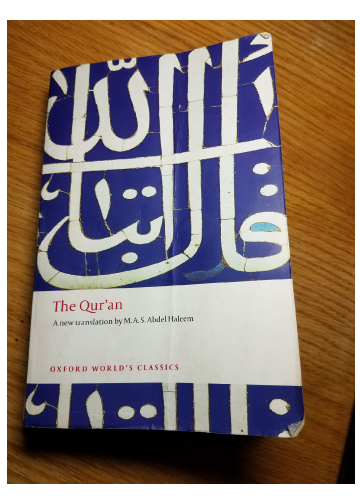
Because most Christians may not have a copy of the Qur’an, or do not have the time or desire to read it, let me provide you with some of the basic differences I found between the Qur’an and the Bible:
- The Qur’an is much smaller, with 450 pages compared to 1500 – 2000 pages in the Bibles we own.
- It was written much later (1,000 – 2,000 years after the Old Testament, and 500 years after the New Testament). This explains why it references the Torah, Psalms and Gospels and includes a number of (altered) stories from the Bible (Abraham, Lot, Moses, Noah, etc.), but the Bible says nothing about Muhammad or the Qur’an.
- The Qur’an has one author (actually, Muhammad did not write it, but rather some of his associates did upon hearing him recite what he learned from the archangel Gabriel) compared to the Bible’s ~35 authors who wrote under the inspiration of God.
- It is organized into 114 books known as suras. These range from 30 pages to one paragraph. Examples include: The Cow, Women, Jonah, Joseph, The Bee and The Elephant. The Bible contains 66 books and is organized into two testaments – the Old and New. Within these testaments, the Bible has distinct sections on the Law, prophecies, proverbs, prayers, gospels, epistles and revelation. The books in the Bible are largely chronological, with the oldest ones in the Old Testament and the newer ones in the New Testament. I could not determine how the suras in the Qur’an were arranged.
- Most of the suras in the Qur’an are similar in terms of their structure and content. They include several descriptions of God, and contrast believers (in Islam) with disbelievers (the former go to a Garden, the latter to Hell). Also, rather than say “God said” or “Allah said,” the suras use the pronoun We. In addition, a surprising number of them include (altered) stories about Noah, Moses, Abraham, Lot, Joseph, etc., from the book of Genesis. The books in the Bible vary in terms of their structure (though a number of Paul’s epistles are similar), and content (history, poetry, proverbs, parables, revelations, etc.).
- There is a fair amount of repetition in the Qur’an. A number of the descriptions for God (such as “control of the heavens and the earth belongs to Him”) are used over and over, as are certain stories found in the Bible. The contrast between believers and disbelievers can be found on nearly every page of the Qur’an.
- The main point of the Qur’an is that there is no god besides the One God, He begot no one nor was He begotten, no one is comparable to Him (see sura Purity of Faith, 112) and any disbeliever (which includes but is not limited to Christians) who believes otherwise is going to hell. The God of the Qur’an is powerful, wise, all knowing and forgiving, etc., but does not appear to be a God of love and grace. The main message of the Bible is redemption, reconciliation (God provided a way for sinners to be forgiven of their sins and reconciled to God again; this is through repentance and faith in Jesus) and righteous living. God’s love and grace are clearly evident.
In my next post, How to Witness to Muslims, Part 2, I’ll provide more details on the Qur’an relative to the Bible, and my concerns with the Qur’an (I think you will be surprised, like I was, at the extent to which it rebukes Christian beliefs).
Part 3 will include my thoughts on how Christians should witness to Muslims based upon my (somewhat limited) experiences in witnessing to them, basic knowledge of the Qur’an and from having read the book, The Gospel for Muslims, by Thabiti Anyabwile.
 Salvation Summaries
Leave a comment